

How UK companies actually get customers online is often misunderstood. Many businesses assume that having a website, running adverts, or posting on social media should naturally lead to enquiries. In practice, customers don’t arrive through a single channel or decision point.
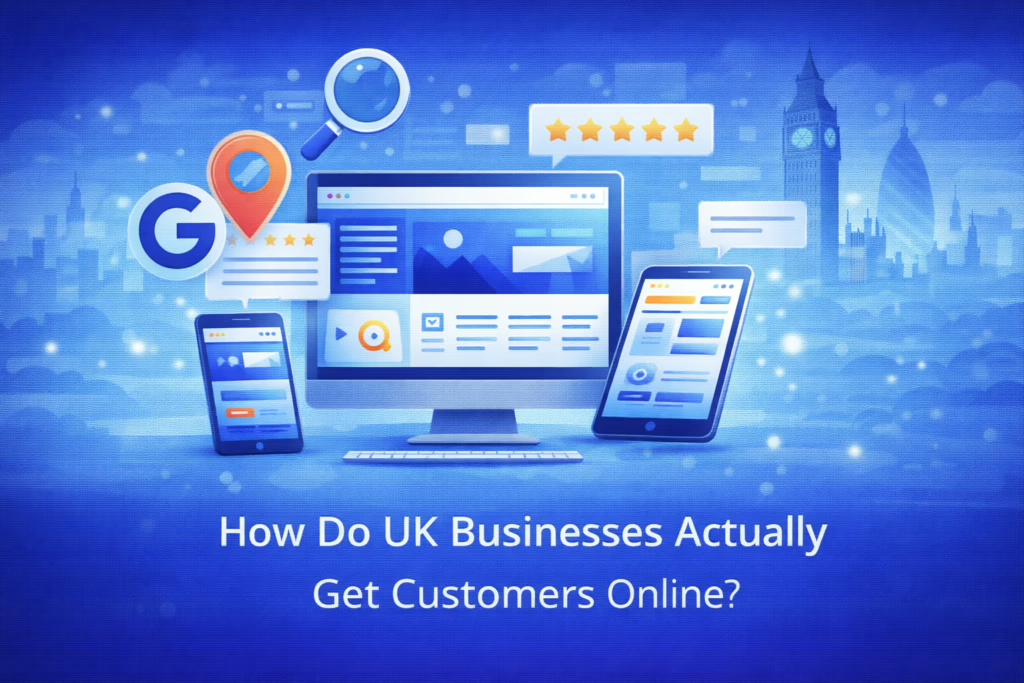
Instead, customers move through a connected journey involving search results, Google Maps, reviews, websites, and overall credibility. Companies that understand and support this journey consistently outperform those that focus on isolated tactics.
This hub explains how that journey really works — and why some businesses generate regular enquiries while others struggle.
Why “being online” isn’t the same as getting customers
One of the biggest mistakes businesses make is assuming that online presence equals online performance. A website can exist without converting. A Google listing can exist without attracting trust. Social media profiles can exist without driving action.
Getting customers online requires more than visibility alone. It requires:
- Being visible in the right places
- Communicating clearly once discovered
- Reinforcing trust at every stage
Without all three, customers hesitate or move on.
The reality of how customers behave online
Understanding how UK customers behave online is key to understanding how businesses get customers.
Most customers:
- Start with Google Search
- Compare several options quickly
- Check Google Maps and reviews
- Visit one or more websites
- Decide who feels safest and easiest to contact
This process often happens in minutes, not days. Companies that remove uncertainty at each step convert more often.
Visibility is the starting point, not the finish line
Visibility is essential, but it only creates opportunity. Customers still need reassurance.
Visibility typically comes from:
- Google Search results
- Google Maps listings
- Occasionally recommendations or social platforms
However, visibility alone doesn’t explain services, pricing, suitability, or professionalism. That job falls to the website and supporting content.
Why websites play a central role in customer decisions
The website is where most decisions are confirmed. Even when customers find a business elsewhere, they often visit the website to answer key questions:
- What exactly does this business do?
- Is it relevant to my situation?
- Can I trust them?
- How do I get in touch?
Websites that fail to answer these questions clearly lose customers — regardless of how strong their visibility is.
This is why businesses with similar rankings can see very different enquiry levels.
Trust is the deciding factor more often than price
Customers don’t always choose the cheapest option. More often, they choose the option that feels safest.
Trust is built through:
- Clear, confident messaging
- Consistent information across platforms
- Professional presentation
- Evidence that the business is established and legitimate
Trust doesn’t come from a single element. It’s reinforced through repetition and consistency.
Why Google Maps and reviews influence action
For many UK businesses, Google Maps plays a major role in how customers decide who to contact. Reviews, proximity, and completeness all influence confidence.
Customers use Google Maps to:
- Validate location
- Check availability
- Compare reputation
- Reduce uncertainty
A weak or inconsistent Google Maps presence can undermine even a strong website.
The role of local SEO in bringing everything together
Local SEO connects visibility, relevance, and trust. It ensures that:
- Search results match what the business actually offers
- Location signals are clear
- Website content reinforces Google listings
Rather than being a standalone tactic, local SEO supports the entire customer journey.
Why some businesses get enquiries consistently
Companies that consistently get customers online usually do a few things well:
- They explain their services clearly
- They reduce friction on their website
- They make contact easy
- They maintain consistency across search, Maps, and content
They don’t rely on tricks or constant strategy changes. They focus on fundamentals.
Why complexity often reduces results
Many businesses overcomplicate online marketing by:
- Chasing new platforms constantly
- Splitting effort across too many channels
- Focusing on tactics before foundations
In contrast, businesses that simplify — and align their visibility, website, and messaging — tend to see steadier results.
How AI-driven search is changing customer discovery
AI-driven search is beginning to influence how customers find and choose companies online. AI systems summarise, compare, and recommend companies based on clarity, consistency, and authority.
This makes:
- Clear explanations
- Structured content
- Consistent messaging
…even more important. Companies that support AI systems with strong foundational content are better positioned as search evolves.
What actually works
UK businesses that get customers online consistently focus on:
- Strong visibility in Google Search and Maps
- Clear, trustworthy websites
- Simple, guided user journeys
- Consistency across all platforms
- Long-term fundamentals over short-term tactics
These principles apply regardless of industry.
How to use this hub
This hub brings together detailed guides that explain each part of the journey in more depth:
- Why some websites don’t convert
- How design and SEO work together
- How customers actually find businesses
- Why some businesses outperform others
- What online marketing really works for small UK businesses
Each guide builds on the same foundations.
Final Thoughts
How UK businesses actually get customers online is not about chasing the latest trend. It’s about understanding behaviour, reducing uncertainty, and making it easy for customers to choose you.
Businesses that focus on clarity, trust, and consistency build momentum over time — and that momentum is what drives sustainable online growth.